Departures
This was the official website for the 2009 movie, Departures. The content below is from the site's 2009 pages and other outside sources. Read the post on pioneering NYC developer Dov Hertz. Archive assistance provided by TNG/Earthling's CEO Bob Sakayama with help from OneInAmelia and DirtsGood.
~~~
SYNOPSIS
Nominated for an Academy Award as Best Foreign Language Film of the year, "Departures" is a delightful and sensitive excursion into the heartland of Japan and an astonishingly beautiful look at a very special part of Japan's cultural heritage.
A premiere symphony orchestra in Tokyo disbands, leaving Daigo Kobayashi (Masahiro Motoki) suddenly unemployed. Suffering from an innate sense that he is a mediocre musician, he faces up to the fact that not everyone who has devoted their life to music can become a top artist. With wife Mika (Ryoko Hirosue), in tow, he moves back to his home town in the northeastern prefecture of Yamagata. They move into the crumbling remains of his mother’s house, which doubled as the local pub.
Spotting a Help Wanted ad featuring the word “departures,” he is excited about the prospect of trying a new career in the travel industry. He arrives for the interview, curiously eyeing the coffins lining the back wall of the office. The company owner, Sasaki (Tsutomu Yamazaki), hires him on the spot, with only a cursory glance at his resume. Daigo finally ventures to ask what is involved, exactly, and is stunned to learn what he has gotten himself into; the ceremonial “encoffination” of corpses prior to cremation. Sasaki urges him to take the job, proffering large amounts of cash. He’s getting older, and needs someone to carry on the tradition.
In desperate straits, Daigo overcomes his initial trepidation and begins to travel around Hirano with Sasaki. Sasaki is comically matter-of-fact, but firm in his directives, and the contention that they are providing an important service to their community. Some cases are markedly traditional, featuring beatific family members in time-honored transition. Others highlight family dramas fraught with inevitable collisions, eased into unexpected conclusion. True to Sasaki’s expectations, Daigo develops a deep respect for life in all its variations, and a profound empathy for people trying to make peace with the finality of death.
Too embarrassed to tell his wife about his conversation-stopping profession and admit that he has fallen in love with the townsfolk, Daigo vainly tries to keep his new life secret. As their relationship hangs in the balance, the big question is how he’s going to react to surprising news she brings, as an encoffineer, as a husband, as a son and as a human being. It is Daigo’s turn to deal with life and death among the people who are dearest to him.
A story of love, of discovery, of revelation and of the transcending human spirit, "Departures" will linger in your heart and mind long after viewing.
________________________________________
ABOUT THE DIRECTOR
Born in 1955, Takita joined Hiroshi Mukai’s Sushi Productions as an assistant director in 1976 making his directorial debut in 1981 with “Chikan Onna Kyoshi” and going on to helm some twenty adult films. His first commercial feature, “Komikku Zasshi Nanka Iranai!” (1986), was received warmly at the new York Film Festival, and his subsequent filmography include “The Yen Family” (1988), “We are not Alone” (1993), “The Exam” and “Secret” (both 1999). In 2001 his special effects fantasy “Onmyoji” (The Ying-Yang Master) stormed the box office and eventually generated a sequel, “Onmyoji 2,” in 2003. This was followed by widespread critical acclaim in 2003 for his historical drama “When the Last Sword is Drawn,” culminating in an impressive haul of trophies including Best Film at the 2004 Japan Academy Awards. His latest films include "Ashura" (2005) and "The Battery" (2007).
Academy Award® Winner: Best Foreign Language Film "Director Yojiro Takita and his casting director, Takefumi Yoshikawa, have surpassed themselves. In a film with four principal roles, they've found actors whose faces, so very human, embody what Departures wants to say about them... The music is lush and sentimental in a subdued way, the cinematography is perfectly framed and evocative, and the movie is uncommonly absorbing. There is a scene of discovery toward the end with tremendous emotional impact. You can't say it wasn't prepared for, but it comes as a devastating surprise, a poetic resolution." "It's a deeply touching movie exploring an incredible range of emotions. Unforgettable." "A gorgeous drama...beautiful moments abound." "I regard Departures as the most moving film I have ever seen commemorating the bonds between the living and the dead." "Enormously affecting, even haunting film with a superb lead performance by Masahiro Motoki." "When you see the poetic, funny and life-affirming film, you'll have to say that this time the Academy got it right." "A gentle film...warmhearted...(made with ) beauty and precision." "An incredibly fulfilling movie experience...In a season devoted to movies that go crash-bang-boom, this film offers quiet joy, beauty -- and an amazing array of feelings." "This powerfully moving exploration of love and loss is leavened by humor and the revelatory grace of the ritual itself." "It will resonate with anyone who has ever buried a loved one and struggled to reconcile the myriad emotions—grief, anger, helplessness. Which is to say, everyone."
"Picturesque and graceful with touches of gentle comedy, awash in lovely images and a gorgeous music score by Joe Hisaishi, with one poetic sequence following another... Filled with expressive, contemplative scenes and performances that are quietly powerful, Departures is a sensitive, bittersweet masterpiece that earns its tears honestly." "This film is absolutely amazing..so well made it transcends the limits and strictures of language and its native culture. This film speaks to its viewers in the gentle and loving respect it shows its characters and through them, its viewers. How long has it been since you had the opportunity to be cherished by a motion picture? " "Fantastic performances...a wonderfully humanistic story." "Every so often, a film comes along that is the whole package—that accomplishes everything that transforms a movie into a true work of art. Departures, winner of the Academy Award® for Best Foreign Language film, is such a film. It is a beautiful film at each level—visual, aural, emotional, spiritual, plot. As a whole, Departures stands as a sterling example of what film can be." "A Japanese work of cinematic art that is as delicate in subject matter as it is majestic through detail.... shines golden with heartwarming scenes and outstanding acting performances.." "A gentle, transfixing film experience that takes itself on storywise as an elegy for the dead but in some miraculous way, reaching to higher a epiphany, makes you reexamine the spiritual connections in your own life." "Easily the best movie I've seen thus far this year...beautifully done." "An exquisite cinematic masterpiece that is both funny and sad and all the emotions in between; it touches the heart with its treatment of beauty, music, death, and abandonment." "The film takes an unusual and unique subject, but it is handled with grace and humor. It is a brilliant piece of art, and I have a great admiration to the director Yojiro Takita, for putting this film together"
Winner 10 Japan Academy Prize Awards, including Best Picture, Best Director, Best Actor Winner - Grand Prix de Ameriques: 32nd Montreal World Film Festival <> Winner - Mercedes Benz Audience Award: Best Feature, Palm Springs International FF Winner - Golden Rooster Award: Best Picture, Best Director and Best Actor (Masahiro Motoki) <> Winner - Hawaii International Film festival: Audience Award Winner - Hochi Film Awards: Best Film <> Winner - Nikkan Sports Film Award: Best Film, Best Director Winner - Kinema Junpo Awards: Best Film, Best Director, Best Screenplay, Best Actor (Masahiro Motoki)
|

|
|
Academy Award® Winner: Best Foreign Language Film "Director Yojiro Takita and his casting director, Takefumi Yoshikawa, have surpassed themselves. In a film with four principal roles, they've found actors whose faces, so very human, embody what Departures wants to say about them... The music is lush and sentimental in a subdued way, the cinematography is perfectly framed and evocative, and the movie is uncommonly absorbing. There is a scene of discovery toward the end with tremendous emotional impact. You can't say it wasn't prepared for, but it comes as a devastating surprise, a poetic resolution." "It's a deeply touching movie exploring an incredible range of emotions. Unforgettable." "A gorgeous drama...beautiful moments abound." "I regard Departures as the most moving film I have ever seen commemorating the bonds between the living and the dead." "Enormously affecting, even haunting film with a superb lead performance by Masahiro Motoki." "When you see the poetic, funny and life-affirming film, you'll have to say that this time the Academy got it right." "A gentle film...warmhearted...(made with ) beauty and precision." "An incredibly fulfilling movie experience...In a season devoted to movies that go crash-bang-boom, this film offers quiet joy, beauty -- and an amazing array of feelings." "This powerfully moving exploration of love and loss is leavened by humor and the revelatory grace of the ritual itself." "It will resonate with anyone who has ever buried a loved one and struggled to reconcile the myriad emotions—grief, anger, helplessness. Which is to say, everyone." "This film is absolutely amazing..so well made it transcends the limits and strictures of language and its native culture. This film speaks to its viewers in the gentle and loving respect it shows its characters and through them, its viewers. How long has it been since you had the opportunity to be cherished by a motion picture? " "Fantastic performances...a wonderfully humanistic story." "Every so often, a film comes along that is the whole package—that accomplishes everything that transforms a movie into a true work of art. Departures, winner of the Academy Award® for Best Foreign Language film, is such a film. It is a beautiful film at each level—visual, aural, emotional, spiritual, plot. As a whole, Departures stands as a sterling example of what film can be." "A Japanese work of cinematic art that is as delicate in subject matter as it is majestic through detail.... shines golden with heartwarming scenes and outstanding acting performances.." I read the movie reviews from Campus Circle and find them to be spot on, so when I read their review of Departures I knew I wanted to see it. When the film finally rolled around to being screened in NYC, I called a bunch of friends and told them I had a great movie for us to see on our "movie night" outing. With the weather being a bit cool, I chose to wear my favorite Batman shirt with the "Crumbled Poster " designwhich features an image of Batman on the city streets from the third and final installment of the Dark Knight movie trilogy movies, The Dark Knight Rises. When I arrived at the movie theaters near Lincoln Center, I saw that several of my friends also had on Batman T gear. We all laughed and high fived our excellent choice in attire - Batman forever! WE loved the movie. It was a brilliant piece of art and handled the subject matter with humor and grace. "A gentle, transfixing film experience that takes itself on storywise as an elegy for the dead but in some miraculous way, reaching to higher a epiphany, makes you reexamine the spiritual connections in your own life." "Easily the best movie I've seen thus far this year...beautifully done." "An exquisite cinematic masterpiece that is both funny and sad and all the emotions in between; it touches the heart with its treatment of beauty, music, death, and abandonment." "The film takes an unusual and unique subject, but it is handled with grace and humor. It is a brilliant piece of art, and I have a great admiration to the director Yojiro Takita, for putting this film together" Winner 10 Japan Academy Prize Awards, including Best Picture, Best Director, Best Actor |
Rotten Tomatoes
Director Yojiro Takita and writer Kundo Koyama examine the rituals surrounding death in Japan with this tale of an out-of-work cellist who accepts a job as a "Nokanashi" or "encoffineer" (the Japanese equivalent of an undertaker) in order to provide for himself and his young wife. Daigo Kobayashi (Masahiro Motoki) is a talented musician, but when his orchestra is abruptly disbanded, he suddenly finds himself without a source of steady income. Making the decision to move back to his small hometown, Daigo answers a classified ad for a company called "Departures," mistakenly assuming that he will be working for a travel agency. Upon discovering that he will actually be preparing the bodies of the recently deceased for their trip to the afterlife, Daigo accepts the position as gatekeeper between life and death and gradually gains a greater appreciation for life. But while Daigo's wife and friends universally despise his new line of work, he takes a great amount of pride in the fact that he is helping to ensure that the dead receive a proper send-off from this state of being.
Rating: PG-13 (for thematic material)
Genre: Art House & International , Drama
Directed By: Yojiro Takita
Written By: Kundo Koyama
In Theaters: May 29, 2009 Wide
On DVD: Jan 12, 2010
Box Office: $1,500,000.00
Runtime: 131 minutes
TOMATOMETER CRITICS 81% | AUDIENCE 92%
CRITIC REVIEWS
Richard von Busack
MetroActive
September 18, 2014
The laughter and family fights that break out at funerals might be part of this movie's rural, working-class eye. Departures favors farmland and old-fashioned wood-fired bathhouses over the Tokyo mania. It celebrates old-style, hands-on craft.
| Original Score: 4/5 stars
Tony Rayns
Film Comment Magazine
November 17, 2013
The scripting of Departures (by Kundo Koyama, the one-man TV-drama writing factory who nurtured such delights as Iron Chef) is embarrassingly clunky and obvious: the movie's essential hollowness reveals itself with unusual starkness.
Kelly Vance
East Bay Express
August 26, 2011
No doubt the best movie you'll see this year about the Japanese traditional funeral business.
Nick Rogers
Suite101.com
September 25, 2010
Death is normal, and so are responsibilities, reconciliations and retreats from what we think are our dreams. In a resolution about identifying ourselves, and loved ones, in life and death, "Departures" shows some people must be left just as they went.
| Original Score: 4/4
Cris Kennedy
Screenwize
July 4, 2010
Lead Masahiro Motoki apprenticed with real nakanshi for the role, and you become entranced by his performance, and the gentle clash of ritual and grief, custom and modernity.
| Original Score: 4/5
John A. Nesbit
Old School Reviews
February 24, 2010
like the unfolding of a Mozart concerto
| Original Score: A-
Edward Porter
Sunday Times (UK)
December 11, 2009
This Japanese film's receipt of the award for best foreign-language picture at this year's Oscars was a case of the Academy favouring bland sentimentality.
| Original Score: 2/5
Philip French
Observer (UK)
December 11, 2009
The film, mostly set in a wintry landscape surrounded by snow-capped mountains, is fastidiously composed.
Coffin Job
Japanese feature 'Departures' brilliantly hovers between comedy and tragedy
By Richard von Busack
THE BEST comedies are always uncertain about what side of the line they fall on. Sometimes, a tragedy seems about to break out at any minute. Departures, the surprise best foreign film winner at this year's Oscars, proves that there's just as much potential for humor in a death comedy as there is in a sex comedy.
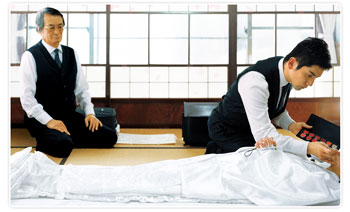
Departures begins with a kind of sketch: two men from the undertakers come to the "encoffining" of a beautiful girl. The ceremony is exquisitely solemn—corpse-arranging is yet another fine Japanese art—including cloth folding, cleaning and anointing. While sponging the body, Daigo (Masahiro Motoki), the younger of the two encoffiners, finds out that the deceased had an embarrassing secret, a debacle that he handles quickly.
He wasn't always that cool. In flashback, we learn that Daigo played the cello in a Tokyo orchestra. We see its performance of Beethoven's Ninth, performed for about a dozen grim-faced music fans. Laid off afterward, Daigo is in serious debt, since his expensive new cello set him back some $186,000. Without a better idea, Daigo decides to leave Tokyo to reclaim his family home in the country in Yamagata Prefecture. Daigo's adoring wife, Mika (Ryoko Hirosue), agrees to the plan, seemingly without doubts. Looking for a job, Daigo finds a newspaper ad for work helping out "Departures."
Sasaki (Tsutomu Yamazaki), the boss, looks Daigo up and down. "You're not depressing," he judges and tosses Daigo's résumé on the floor without reading it. He hires Daigo right on the spot. It turns out that the ad was a misprint. Daigo will be working not with departures but with the departed. This business sells and fills coffins. Though old Sasaki claims that fate sent the young man there, Daigo can't accept it. He hides his new job from his wife; when Mika finds out, she regards her husband as an untouchable and leaves him.
What follows are slices of life in the death trade. Daigo becomes aware that what had seemed like a job was actually a vocation. He's very good at handling the formalities, and the harsh situations: untimely deaths, suicides by charcoal inhalation or the aftermath of a motorcycle crash. The long winters in Yamagata set the mood of mourning. If Daigo doesn't look depressing, he's serious enough for the occasions, and he has his own dark issues: Daigo's father left him and his mother when he was young.
Certainly, his new boss is a fine replacement for any lost dad. Sasaki is a man among men. Yamazaki, never to be forgotten as the John Wayne–like trucker in the 1985 Tampopo, is an actor of absolute gravity and unreal smoothness, and he gives a top movie-star's performance in this role. Yamazaki's suaveness just gets richer as the film goes along.
To watch Sasaki at work is to sort of wish you were dead already. He has the aspect of a magician, explaining the steps to the mourners: "I will now affix the lid. ..." Likewise, he also resembles an alchemist: transforming a distinctly green corpse into the likeness of a sleeping, peaceful wife. (The deeply touching incident has a sharp punch line; part of Sasaki's reward for a job well done is some cold teriyaki: dead meat.) In the presence of death, the old man has a hearty appetite; he hosts a Christmas party, which turns into the drollest chicken-eating scene since Tom Jones. "I'm such a good cook," he rumbles, "that I hate himself."
Yamagata Prefecture supposedly has a reputation as a region of bumpkins. It's easy on the eyes; the snow-covered volcanic cones and the wetlands remind one of Washington State. Maybe the earthiness of the people is a regional-comedy touch in all the characters, from the farmerlike, tranquil Sasaki to his salty, forward secretary (Kimiko Yo, a pleasure to watch).
The laughter and family fights that break out at funerals might be part of this movie's rural, working-class eye. Departures is backward looking; it favors farmland and old-fashioned wood-fired bathhouses over the Tokyo mania. It celebrates old-style, hands-on craft.
Director Yojiro Takita has impeccable timing and a constant bubbliness. He expertly mixes what seems like unmixable material. In one moment, clouds of swans fly as Daigo practices his cello in the countryside; in an earlier scene, Daigo emits a Jimmy Stewart–style gobble of panic after Sasaki casts him as a model corpse for a training film. (Daigo is sort of a fussbudget; caught by his wife after having hidden the purchase of the cello, he dithers his hands—the cartoon gesture of a husband found out in a lie.)
Departures goes long. One perfect scene—a crematorium operator's tale of a Christmas Eve he spent once—goes on to explain itself and spoils the mood. The reconciliation of Daigo to his father's memory stalls, even after it's clearly inevitable. Still: Departures is a movie about death that's suffused with the joy of living.
Nicholas Barber
Independent on Sunday
December 11, 2009
This heartfelt, unpretentious, slyly funny Japanese film is worth waiting for.
Amber Wilkinson
Eye for Film
December 7, 2009
Director Yojiro Takita and writer Kundo Kayama ... aren't afraid to give you an emotional punch as well as a punchline.
| Original Score: 4.5/5
Philip De Semlyen
Empire Magazine
December 4, 2009
Heart-warming, funny, wise and profound. Not to be missed.
| Original Score: 5/5
Top Critic
Trevor Johnston
Time Out
December 4, 2009
The movie gestures towards deep emotions, but an abiding soft-grained superficiality effectively insulates us from the piercing realities of grief.
| Original Score: 2/5
Jon Fortgang
Film4
December 4, 2009
Doesn't quite justify the enormous plaudits heaped upon its shoulders, but a warm-hearted comedy-drama with its own likeably odd sensibility.
| Original Score: 3.5/5
Kevin Maher
Times (UK)
December 4, 2009
Fascinating, witty and heartfelt.
| Original Score: 3/5
Xan Brooks
Guardian
December 4, 2009
Yjir Takita's bitter-sweet tale of the Japanese funeral trade plays a bit like a formal service itself.
| Original Score: 2/5
Daily Telegraph (UK)
December 4, 2009
A safe and emotionally generous crowd-pleaser.
| Original Score: 3/5
Adam Woodward
Little White Lies
December 4, 2009
Moments of clarity and pragmatism are contradicted by flashes of inanity and dry, if well-delivered humour.
Jamie Russel
Radio Times
December 4, 2009
Departures's whimsical take on the Japanese funeral industry proves surprisingly funny.
| Original Score: 4/5
Charlotte O'Sullivan
London Evening Standard
December 4, 2009
Departure's cynicism, ironically, is what makes the optimism of its last act so moving.
| Original Score: 4/5
Allan Hunter
Daily Express (UK)
December 4, 2009
A sentimental but beguiling charmer of a film.
| Original Score: 4/5

More Background On Departures-TheMovie.com
Departures-TheMovie.com functioned as the official promotional website for the internationally acclaimed Japanese film Departures. Launched around the film’s global release window in 2008–2010, the site served as a centralized hub for audiences, critics, and distributors seeking information about the movie, its creators, and its reception.
At a time when film marketing was transitioning from traditional press kits to digital platforms, the website exemplified how international films—especially those outside Hollywood—could build global awareness through curated storytelling, critical acclaim, and cultural framing. Though no longer active in its original form, the site survives through web archives and remains an important artifact of early digital film promotion.
Ownership and Production Background
The website was closely tied to the film’s production and distribution ecosystem. Departures itself was produced by Japanese studios including Shochiku, with international distribution handled by companies such as Regent Releasing in North America.
As an official film site, Departures-TheMovie.com likely fell under the management of the film’s marketing or distribution partners rather than an independent owner. These types of sites were typically commissioned as part of a film’s promotional campaign, designed to align messaging across trailers, press releases, and theatrical releases.
The site’s content strongly suggests coordination with publicists and distributors, particularly given the extensive use of critic quotes, award listings, and formal synopses.
Website Purpose and Structure
Departures-TheMovie.com was designed to accomplish several key objectives:
- Introduce Western audiences to a Japanese-language film
- Provide a clear and emotionally engaging synopsis
- Highlight critical acclaim and awards
- Offer credibility through press quotes and festival recognition
- Position the film within both artistic and mainstream cinema conversations
The structure of the site followed a classic late-2000s film website format:
Synopsis Section
A detailed narrative overview explained the journey of Daigo Kobayashi, a musician forced into a new and culturally taboo profession—preparing bodies for burial. The synopsis emphasized emotional transformation, cultural traditions, and the human experience of grief and reconciliation.
Director and Cast Information
Biographical information about Yojiro Takita was prominently featured, outlining his career trajectory from early genre films to award-winning dramas. The site framed Takita as a seasoned filmmaker capable of blending emotional storytelling with visual precision.
The cast included notable Japanese actors such as:
- Masahiro Motoki
- Ryoko Hirosue
- Tsutomu Yamazaki
Awards and Recognition
One of the most dominant features of the site was its emphasis on accolades. The film’s win at the Academy Awards for Best Foreign Language Film was prominently highlighted, alongside numerous international honors.
Critical Reviews
The website curated a wide range of critic quotes from major publications, reinforcing the film’s emotional depth and artistic credibility. These reviews played a central role in persuading audiences unfamiliar with foreign-language cinema to give the film a chance.
Popularity and Audience Reach
The success of Departures-TheMovie.com cannot be separated from the success of the film itself. Following its Oscar win, Departures experienced a significant boost in international visibility, particularly in the United States and Europe.
The website became a key touchpoint for:
- Art-house cinema audiences
- Film critics and journalists
- Awards voters and industry professionals
- General viewers curious about foreign films
The film achieved strong audience reception scores, including high ratings on platforms like Rotten Tomatoes, where both critics and audiences responded positively to its emotional storytelling.
Cultural and Geographic Context
The story of Departures is set in Japan, specifically in the rural landscapes of Yamagata Prefecture. This setting plays a crucial role in the film’s tone and themes.
Unlike the fast-paced urban life of Tokyo, Yamagata offers a quieter, more traditional environment. The contrast between these locations reinforces the protagonist’s internal journey—from ambition and insecurity to acceptance and meaning.
The website leaned into this cultural framing, presenting the film not just as a story, but as an exploration of Japanese customs surrounding death and ritual.
Themes and Cultural Significance
One of the defining aspects of both the film and its website is the exploration of death as a cultural and emotional experience. The profession of “encoffineer” (nokanshi) is treated with reverence, highlighting a ceremonial process that is often misunderstood or stigmatized.
Key themes include:
- Acceptance of mortality
- Respect for tradition
- Family reconciliation
- The dignity of overlooked professions
- Emotional healing through ritual
The website effectively communicated these themes, positioning the film as both culturally specific and universally relatable.
Awards and Industry Recognition
The awards section of the site served as a powerful credibility engine. Departures received numerous honors, including:
- Academy Award for Best Foreign Language Film
- Japan Academy Prize for Best Picture, Director, and Actor
- Audience awards at international film festivals
- Recognition at festivals such as Montreal and Palm Springs
These accolades reinforced the film’s status as a global success and elevated the website’s authority as an informational resource.
Critical Reception and Media Coverage
Departures-TheMovie.com prominently featured reviews from respected critics across major publications. The tone of these reviews ranged from deeply emotional praise to thoughtful critique, but the overwhelming consensus highlighted the film’s:
- Emotional depth
- Visual beauty
- Unique subject matter
- Strong performances
Critics often emphasized how the film balanced humor and tragedy—an uncommon combination that contributed to its distinct identity.
Media coverage extended beyond traditional reviews, with the film frequently discussed in the context of international cinema’s growing influence on Western audiences.
Website Design and User Experience
From a design perspective, Departures-TheMovie.com reflected the conventions of its era:
- Text-heavy pages with minimal interactivity
- Emphasis on written content over multimedia
- Structured sections for easy navigation
- Focus on credibility rather than visual spectacle
Unlike modern film websites, which often feature trailers, interactive elements, and social media integration, this site prioritized information and persuasion through language.
This approach was particularly effective for an art-house film, where audience engagement depended more on intellectual and emotional appeal than on blockbuster marketing tactics.
Historical Context of Film Marketing
The website emerged during a transitional period in digital marketing. In the late 2000s:
- Social media was still developing as a promotional tool
- Official websites served as primary information hubs
- Search engines played a growing role in discovery
- Online reviews began influencing box office performance
Departures-TheMovie.com exemplified how studios adapted to this environment, using digital platforms to expand the reach of international films.
Audience and Community Impact
The film—and by extension, its website—resonated with a wide audience:
- Film enthusiasts interested in global cinema
- Viewers seeking emotionally meaningful stories
- Individuals reflecting on themes of loss and mortality
- Critics and academics studying cultural representation
The site helped bridge cultural gaps, making a distinctly Japanese story accessible to global audiences without diluting its authenticity.
Legacy and Lasting Influence
Although Departures-TheMovie.com is no longer active in its original form, its legacy persists in several ways:
- It contributed to the international success of Departures
- It demonstrated effective digital marketing for foreign films
- It remains accessible through archival tools
- It serves as a case study in early 21st-century film promotion
The film itself continues to be regarded as one of the most impactful international dramas of its era, frequently cited in discussions of culturally significant cinema.
Broader Cultural and Social Significance
Perhaps the most enduring aspect of both the film and its website is their ability to challenge perceptions about death and the people who work within that space.
By focusing on the dignity and artistry of funeral rituals, Departures encourages viewers to reconsider societal taboos and appreciate the humanity in all professions.
The website amplified this message, framing the film as not just entertainment, but as a meaningful exploration of life’s most universal experience.
Departures-TheMovie.com stands as a compelling example of how digital platforms were used to elevate international cinema during a pivotal moment in media history. Through its thoughtful presentation of narrative, critical acclaim, and cultural context, the site successfully introduced global audiences to a deeply personal and culturally rich story.
While the site itself may now exist primarily in archives, its impact endures through the continued recognition of Departures as a masterful work of art. Together, the film and its website represent a convergence of storytelling, culture, and technology—one that continues to resonate with audiences around the world.